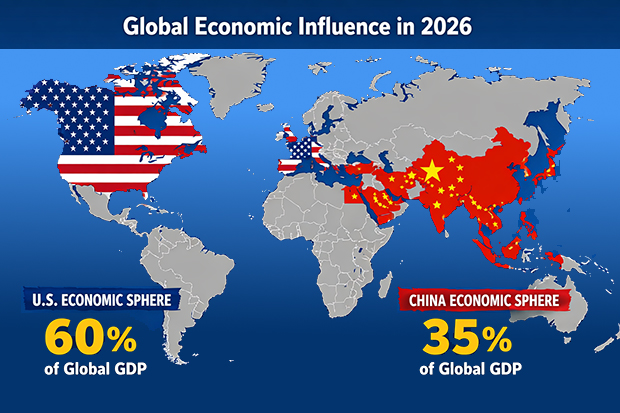
Business News, January 1, 2026: As 2026 begins, the world’s two largest economies — the United States and China — are navigating markedly different paths. While the U.S. shows signs of steady but modest growth, China is projected to expand at a pace more than double that of its Western counterpart. Experts say these contrasting trajectories underscore not only differing policy priorities but also the structural challenges each nation faces.
U.S. Growth: Steady but Moderate
In Washington, economists are signaling cautious optimism. According to the Federal Reserve’s December 2025 forecast, U.S. real gross domestic product (GDP) is expected to grow around 2.3% in 2026. Surveys of professional forecasters, including the Philadelphia Fed, place the likely range between 1.8% and 1.9%, while some private analysts, such as Goldman Sachs, suggest growth could edge toward 2.6%, boosted by tax incentives and reduced trade drag.
“The U.S. economy is in a soft-landing phase,” said Dr. Emily Chen, a senior economist at the Brookings Institution. “Consumer spending remains resilient, and fiscal policies are providing a buffer against external shocks, but growth won’t reach the levels we saw immediately post-pandemic.”
The labor market remains relatively healthy, though less robust than in previous years. Unemployment is projected to stabilize around 4.4%–4.5%, signaling a slight cooling from ultra-low levels while still maintaining ample room for flexibility. Inflation, a continuing concern for the Federal Reserve, is expected to hover around 2.4% by year-end, prompting a cautious approach to interest rates.
Technological investment, particularly in artificial intelligence, continues to serve as a key structural driver. Fiscal stimulus in the form of the “One Big, Beautiful Bill” is designed to support both consumption and corporate investment, reinforcing moderate economic growth amid global uncertainties.
China’s Trajectory: Faster Growth Amid Structural Pressures
Meanwhile, Beijing is targeting a markedly higher growth rate. International forecasts indicate China’s GDP could expand by 4.4%–4.8% in 2026, with some private estimates even approaching 5%.
“China is still in a catch-up phase,” said Li Wei, senior analyst at the Economist Intelligence Unit. “Infrastructure investments and government stimulus are keeping growth robust, even as demographic pressures and a slower labor market weigh on long-term momentum.”
Unlike the U.S., China faces structural labor market pressures, including an aging population and slower job creation in traditional sectors. Consumer demand remains subdued compared with pre-pandemic levels, exacerbated by a property market slump and moderate wage growth. Inflation is generally low, with certain sectors experiencing deflationary pressures, giving the People’s Bank of China room for measured monetary easing.
Policy remains proactive. Beijing is emphasizing infrastructure expansion, subsidies, and investment in high-tech industries to stimulate consumption and innovation. Analysts caution, however, that China’s headline growth masks underlying vulnerabilities in household income, the property sector, and domestic demand.
Comparing the Giants
When placed side by side, the contrast is clear:
- GDP Growth: U.S. 1.8%–2.6% vs. China 4.4%–4.8%
- Labor Market: U.S. stable with moderate unemployment vs. China under structural pressures
- Inflation: U.S. slightly above target vs. China mild to low
- Policy Focus: U.S. cautious monetary and fiscal incentives vs. China proactive infrastructure and stimulus
Economists note that these differences have global implications. While China’s faster growth fuels regional and global supply chains, the U.S.’s stability supports consumption-driven demand worldwide. Both economies face uncertainties: the U.S. from policy volatility and geopolitical tensions, and China from demographic shifts and domestic structural imbalances.
Outlook
For 2026, the U.S. economy is likely to deliver a soft landing, characterized by steady growth, resilient consumption, and measured monetary policy. China is set to maintain faster expansion, albeit with structural constraints that could limit long-term sustainability. Together, their performance will shape global trade, investment flows, and market sentiment, underscoring the interlinked nature of the modern global economy.
As investors, policymakers, and businesses look ahead, the narrative is clear: the U.S. and China are walking divergent paths — one steadier, one faster — but both pivotal to the health of the global economic system.