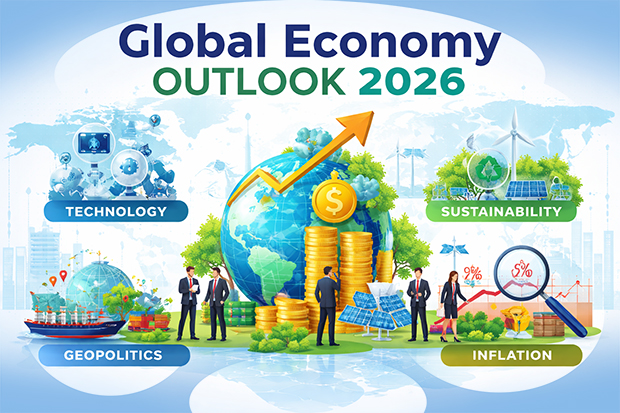
Business News, January 1, 2026: As the world ushers in 2026, policymakers, investors, and businesses are preparing for a year that promises both opportunities and challenges on the global economic stage. Following a period marked by geopolitical tensions, technological acceleration, and post-pandemic recovery, the global economy is poised for moderate growth, with key trends shaping priorities for governments, corporations, and consumers alike.
The year 2026 presents a complex but promising global economic landscape. Growth will be tempered by inflationary pressures and geopolitical uncertainties, but opportunities abound in technology, sustainability, and workforce innovation. Governments, businesses, and investors must remain agile, adopting forward-thinking strategies to navigate risks while capitalizing on emerging trends.
Ultimately, the main focus for 2026 will be resilience and adaptability—building economies that are capable of withstanding shocks, embracing technological and environmental imperatives, and fostering inclusive growth. For policymakers and corporate leaders alike, this will require careful planning, strategic investment, and a commitment to sustainable, long-term prosperity.
Global Growth Outlook
The International Monetary Fund (IMF) and other leading economic bodies project a modest expansion of the global economy in 2026. While some advanced economies may experience steady, albeit slower growth due to inflationary pressures and fiscal tightening, emerging markets are expected to lead the global growth momentum, driven by robust domestic demand and continued digital transformation.
Inflation remains a focal point for central banks around the world. After years of accommodative monetary policy, 2026 is likely to see a continued balancing act between maintaining price stability and supporting growth. The key challenge will be managing inflation without stifling innovation or investment, particularly in sectors such as green energy, technology, and infrastructure development.
Technology and Digital Transformation
Technology will remain a driving force in 2026, with artificial intelligence, automation, and advanced data analytics reshaping industries. Businesses will increasingly invest in digital tools to enhance efficiency, improve decision-making, and create new revenue streams. The proliferation of AI-powered solutions in finance, healthcare, manufacturing, and logistics is expected to accelerate productivity gains while also requiring new governance and ethical standards.
Moreover, cybersecurity will continue to be a primary concern, as global interconnectivity exposes economies to heightened risks. Governments and organizations will prioritize investments in secure digital infrastructure to protect sensitive data, ensure business continuity, and maintain consumer trust.
Sustainability and Green Economy
Climate change and environmental sustainability are likely to dominate economic agendas in 2026. Governments and corporations are expected to continue investing heavily in renewable energy, carbon reduction initiatives, and sustainable supply chains. The transition to a green economy is no longer optional; it has become a central pillar of economic strategy. Investors are increasingly considering environmental, social, and governance (ESG) criteria when evaluating opportunities, signaling a broader shift toward responsible, long-term economic planning.
Geopolitical and Trade Considerations
Global trade patterns and geopolitical dynamics will also shape economic outcomes in 2026. Trade agreements, regional partnerships, and political developments will influence investment flows and market stability. Businesses will need to remain agile to navigate uncertainties in supply chains, trade regulations, and international relations. Diversification of markets and sourcing strategies is likely to be a key focus for multinational companies seeking to mitigate risks and capitalize on emerging opportunities.
Focus on Workforce and Skills
As industries evolve, workforce development will be crucial. Upskilling and reskilling programs will become essential for both public and private sectors to ensure that employees can meet the demands of new technologies and changing business models. Companies investing in human capital will gain a competitive edge, fostering innovation and resilience in an increasingly dynamic economic environment.
Consumer Trends and Market Shifts
Consumer behavior is also expected to influence economic trends in 2026. Increased digital engagement, shifting preferences toward sustainable products, and the rise of experiential consumption will create opportunities for businesses that can respond swiftly and creatively. E-commerce, fintech, and personalized services are likely to experience further expansion as technology enhances convenience and accessibility.