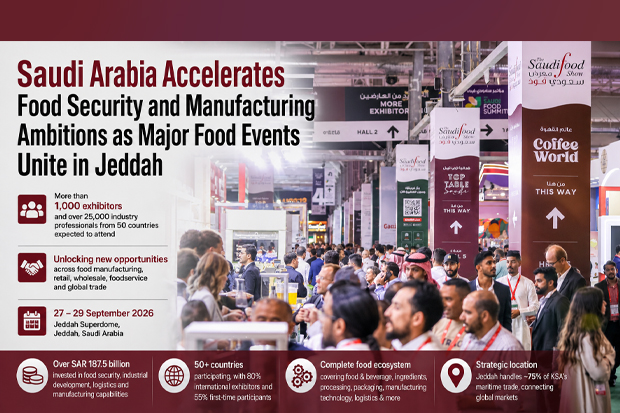
Saudi Arabia is strengthening its position as a regional food production and trade hub, backed by more than SAR 187.5 billion in investment across food security, industrial development, logistics and manufacturing.
Jeddah, Saudi Arabia, 24 August 2026: Saudi Arabia is accelerating efforts to develop a more resilient and self-sufficient food ecosystem as the Kingdom expands local manufacturing capacity, strengthens food security and builds deeper connections with international supply chains.
Reflecting this strategy, The Saudifood Show and Saudifood Manufacturing will be held together for the first time in Jeddah from 27–29 September 2026, creating an integrated platform connecting food production, manufacturing, sourcing, distribution and trade.
Held at Jeddah Superdome in strategic partnership with the Saudi Authority for Industrial Cities and Technology Zones (MODON), the combined events are expected to attract more than 1,000 exhibitors and over 25,000 industry professionals from 50 countries.
The scale of the events reflects the rapid development of Saudi Arabia’s food economy under Vision 2030. More than SAR 187.5 billion has been invested in areas including food security, industrial development, logistics infrastructure and manufacturing capabilities.
Building an integrated food ecosystem
The combined platform will bring together companies operating throughout the food value chain, including food manufacturers, ingredient suppliers, processing and packaging companies, technology providers, logistics operators, distributors, retailers, wholesalers and foodservice businesses.
Major food companies expected to participate include Almarai, Arla, Lactalis, BRF, Tanmiah, NADEC, Savola, First Mills, Americana and Seara Food Middle East. The manufacturing event will also bring together industrial suppliers including Bunge, JBT Marel, Middleby, MULTIVAC, NAPCO, Zamil, ULMA and Provisur.
International participation will be significant, with around 80% of exhibitors coming from outside Saudi Arabia, while 55% are expected to participate for the first time. International pavilions and delegations will represent markets including Türkiye, India, Jordan, the United States, Uzbekistan, Tunisia, Italy, Slovakia, Sri Lanka, Pakistan, Brazil and Japan.
Jeddah’s strategic role
Moving the events to Jeddah strengthens their connection to Saudi Arabia’s logistics and international trade infrastructure.
The city serves as a major gateway between the Kingdom and markets across the Middle East, Africa, Asia and Europe and, according to the event organisers, handles approximately 75% of Saudi Arabia’s maritime trade.
Bringing food trade and food manufacturing together in Jeddah is expected to create new opportunities for localisation, sourcing, investment, industrial partnerships and international trade, while connecting Saudi producers with technologies and global suppliers.
The initiative also supports the broader Vision 2030 objective of developing domestic industries, strengthening supply-chain resilience and reducing vulnerabilities in strategically important sectors.
With food security increasingly linked to manufacturing capability, logistics and international trade, Saudi Arabia’s expanding food ecosystem is emerging as an important component of the Kingdom’s wider economic diversification strategy.