Executive Summary
AI investment is becoming a new driver of inflation.
Business costs remain under pressure from energy and supply chains.
The Fed is balancing easing inflation with persistent cost risks.
Interest-rate decisions will depend on both inflation and business investment.
BN REPORT, 22 July 2026: For much of the past two years, the Federal Reserve’s battle against inflation has focused on cooling consumer demand through higher interest rates. Today, however, policymakers are facing a more complex challenge—one driven not only by consumers, but increasingly by the cost of doing business.
Recent inflation data has offered encouraging signs that price growth is slowing, strengthening expectations that the Federal Reserve could begin easing monetary policy in the coming months. Yet beneath the headline figures, executives across multiple industries continue to report persistent cost pressures that threaten to keep inflation above the Fed’s long-term target.
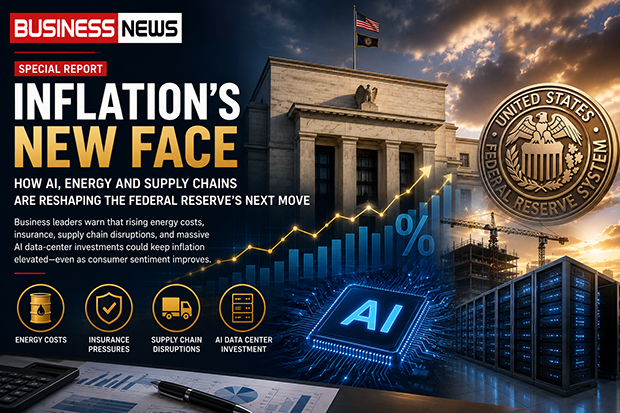
Among the biggest concerns are rising energy prices, escalating insurance premiums, ongoing supply chain disruptions, and the unprecedented wave of investment flowing into artificial intelligence infrastructure.
AI Becomes a New Inflation Driver
Artificial intelligence is rapidly transforming industries, but it is also creating a new source of economic pressure.
Technology giants are investing hundreds of billions of dollars in AI-powered data centers, advanced semiconductor manufacturing, cloud infrastructure, high-performance networking, and electricity generation to support the next generation of AI services.
These investments are fueling demand for construction materials, skilled labor, electricity, cooling systems, and specialized equipment—placing upward pressure on costs across multiple sectors of the economy.
Unlike temporary supply shocks, AI infrastructure spending is expected to continue for years, making it a structural factor that policymakers must increasingly consider when evaluating inflation risks.
Business Leaders Warn of Persistent Cost Pressures
Corporate executives continue to report that operating costs remain elevated despite improving inflation readings.
Higher transportation expenses, increased insurance costs, volatile energy markets, and global supply-chain adjustments are reducing profit margins and limiting pricing flexibility.
Many businesses are also absorbing higher technology and cybersecurity costs while accelerating investments in digital transformation to remain competitive in an AI-driven economy.
For the Federal Reserve, these business realities present a more nuanced picture than consumer inflation data alone.
What This Means for Interest Rates
While markets remain optimistic that lower inflation could eventually open the door to interest-rate cuts, Federal Reserve officials are likely to remain cautious.
The central bank must balance encouraging inflation trends against the possibility that structural business costs could keep underlying inflation elevated for longer than expected.
As a result, future policy decisions are expected to depend not only on consumer price data but also on business investment trends, labor market conditions, corporate earnings, and the long-term economic impact of AI-related capital spending.
The Investment Perspective
For investors, inflation is entering a new phase.
Rather than being driven primarily by consumer demand, future inflation may increasingly reflect the cost of building the digital economy—from semiconductor fabrication plants and AI data centers to energy infrastructure and advanced manufacturing.
Companies that successfully improve productivity through artificial intelligence may offset some of these costs over time. However, businesses that fail to convert record AI investment into sustainable earnings could face growing pressure from both investors and policymakers.
Business News Analysis
The narrative surrounding inflation is evolving. The debate is no longer centered solely on consumer spending or wage growth—it is increasingly about the enormous capital investment required to power the next generation of artificial intelligence.
Whether these investments ultimately drive productivity gains that reduce inflation or create prolonged cost pressures will be one of the defining economic questions facing global markets over the coming years.
For now, one conclusion is becoming increasingly clear: the Federal Reserve’s next decisions will be shaped as much by the AI economy as by traditional inflation indicators.
Recommended Reading
- Federal Reserve – Monetary Policy Reports & Interest Rate Decisions
https://www.federalreserve.gov/monetarypolicy.htm - U.S. Bureau of Labor Statistics (BLS) – Consumer Price Index (CPI)
https://www.bls.gov/cpi/ - McKinsey & Company – The Economic Potential of Generative AI
https://www.mckinsey.com/capabilities/quantumblack/our-insights/the-economic-potential-of-generative-ai-the-next-productivity-frontier